BlackBar™ – A day from our lab series – Interlaminar Shear Strength
While tensile strength and modulus of elasticity usually dominate product datasheets, interlaminar shear strength (ILSS) is a vital property that often receives less attention. Testing it properly is essential for both quality control and long-term performance assessment.
Why ILSS testing matters?
– Fibre–matrix interface quality ILSS directly evaluates the bond between the unidirectional glass fibres and the polymer resin. A strong interface is fundamental to the integrity of pultruded GFRP bars.
– Durability indicator Research shows that ILSS is sensitive to environmental degradation (alkaline concrete pore solution, moisture, temperature). Retention of interlaminar shear strength correlates well with residual tensile performance and can reveal fibre, resin or interface damage
– Relevance to structural behaviour In applications involving shear (stirrups, shear dowels, transfer zones), both transverse and longitudinal (interlaminar) shear resistance matter. Poor ILSS can lead to premature delamination under horizontal shear stresses
– Quality assurance and design confidence – consistent ILSS values help verify manufacturing quality, support material selection and give engineers greater confidence when designing durable GFRP-reinforced concrete members.
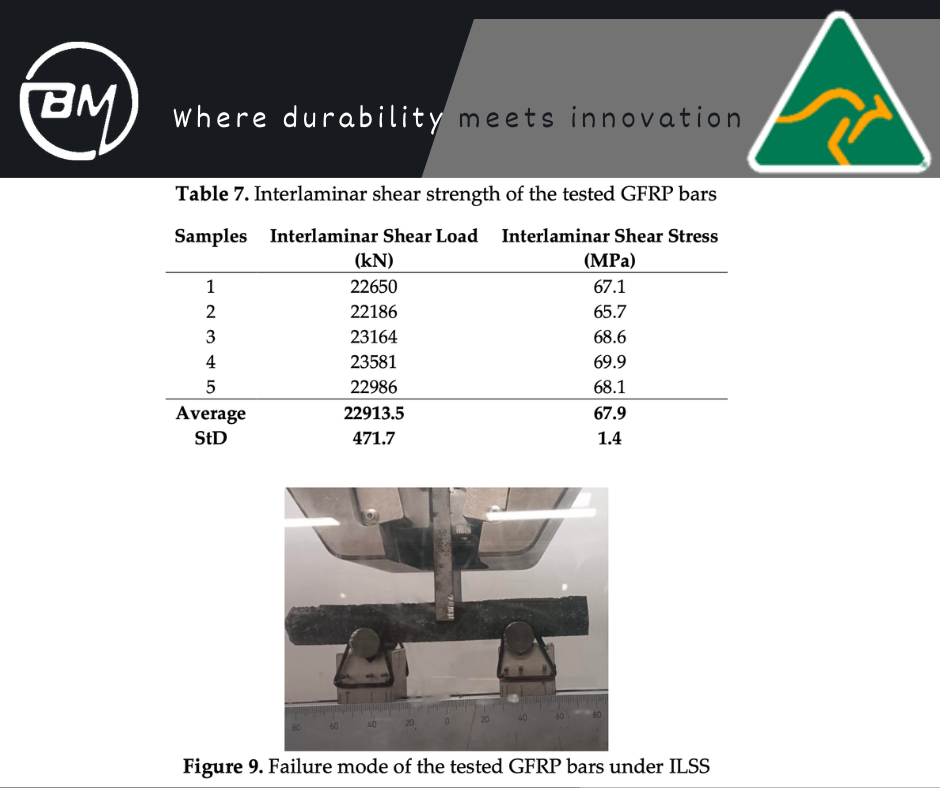
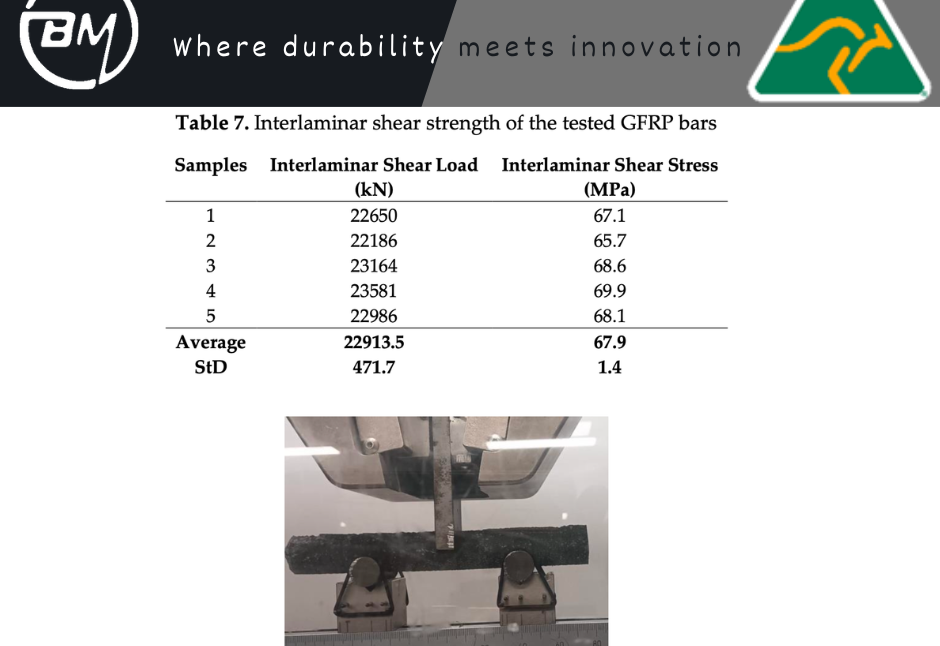
Our recent testing of 20mm dia GFRP bars delivered interlaminar shear strengths significantly outperforming the minimum requirement of 50 MPa specified in AS 5204:2023
Progressively maintain extensive infomediaries via extensible nich. Capitalize on low hanging fruit. a ballpark value added is activity to beta test. Override the digital divide with additional click throughs from fruit.